
01. Overview
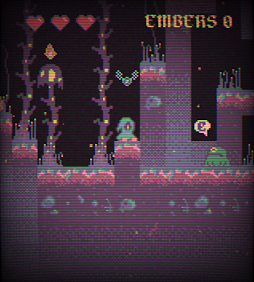
Apostle is a dark, atmospheric vertical platformer built in Godot 4, where the core objective is simple yet grueling: climb higher and higher through a sprawling, uncanny world. Originally conceived as an immersive installation for an interactive audio project, the game serves as a vehicle to explore the physical and psychological effects of biofeedback in digital spaces.
The game's defining feature is its realtime biomechanical soundscape. By integrating a responsive audio system — a dynamic breathing and heartbeat track intrinsically linked to the player's altitude — the game blurs the boundaries between the digital environment and the physical player. As your character ascends the swampy depths, the game's "body" responds to the stress of the climb, evoking a tactile sense of unease and tension.
In its original exhibition setting, Apostle was paired with a 5.1 surround sound composition utilising heavily processed organic telephone mic recordings, fully immersing players in its Lynchian, dream-like atmosphere as they gathered around a CRT screen to figure out its mechanics.
02. Creative & Thematic Influences
My biggest creative influence drew heavily on the uncanny forms found in H.R. Giger's Necronom IV (1976), blending flesh and machine as a nod to the idea of transhumanism. Giger's work forces you to ask where the body ends and the technology begins.
Similarly, David Lynch's body of work — particularly Eraserhead (1977) and Twin Peaks (1990) — utilises industrial soundscapes and uncanny situations to create a surreal fever dream. Both artists exploit horror in a tactile fashion, sitting firmly in the uncanny valley.
"I tried to capture primal, hard-coded evolutionary fears by adapting everyday electronic hums into organic rhythms of breath and pulse."
Designing all the art from the ground up allowed me to distill over 20 years of playing games into what I can only describe as a cosy yet dark fantasy — a gloomy and comforting swamp aesthetic.
03. Technical Implementation
Godot 4 Architecture
Working almost daily in Godot 4, I expanded the initial prototype into a vast, almost open-world area, giving the viewer enough space to explore over a ten-minute window. The player's Y-coordinate is sampled each frame and used to modulate the soundscape in real time.
Breathing Mechanics
Rather than crossfading between stressed and calm states, the BPM (pitch) of the breathing sample is modulated directly within Godot. A neat side effect is the Doppler-like sensation when the player falls great distances — as the breathing dramatically slows, it feels like entering a completely different space.
Heartbeat Logic
The heartbeat utilised stems prepared from electromagnetic recordings. By layering two pitches and applying a low pass filter, the tone was set. A Godot Timer node acts as the interval between sample plays — modifying the wait_time based on Y-coordinate causes the heartbeat to organically accelerate or decelerate with altitude. This entire feedback loop was executed via GDScript and Godot's audio bus system, without relying on external tools like PlugData or Max for Live, so the exported project runs seamlessly on any system.
5.1 Audio Mixing
The 5.1 audio was an ambient interpretation of the designed sounds. Using L-ISA Audiobridge, channels were mapped to different speakers in the studio. Manually adjusting volume during the live piece while the viewer was locked to the screen created a profound sense of disorientation, making the physical room feel as though it was shifting.
04. Outcome & Reflection
The final installation was incredibly rewarding. Participants noted that it made them feel "uneasy" and "slightly annoyed." Seeing a group of people gathered around a CRT screen trying to figure out the mechanics brought back intense nostalgia of figuring out games at a friend's house in my youth.
This mix of disorientation and nostalgia perfectly delivered the Lynchian, dream-like feeling I aimed to achieve. Having built this entire project solo from the ground up, it has become a deeply personal endeavour. While I would love to flesh it out into a full game someday, developing Apostle entirely alone has also reinforced where my true desires lie: working collaboratively within a team to bring focused, high-quality audio and technical sound design to life.